Clinical research website + SEO

    Salud Clinical Services — Clinical Research Website Platform

    Creating a multi-audience digital platform connecting research participants, physicians and clinical-trial sponsors.

    Visit the live website
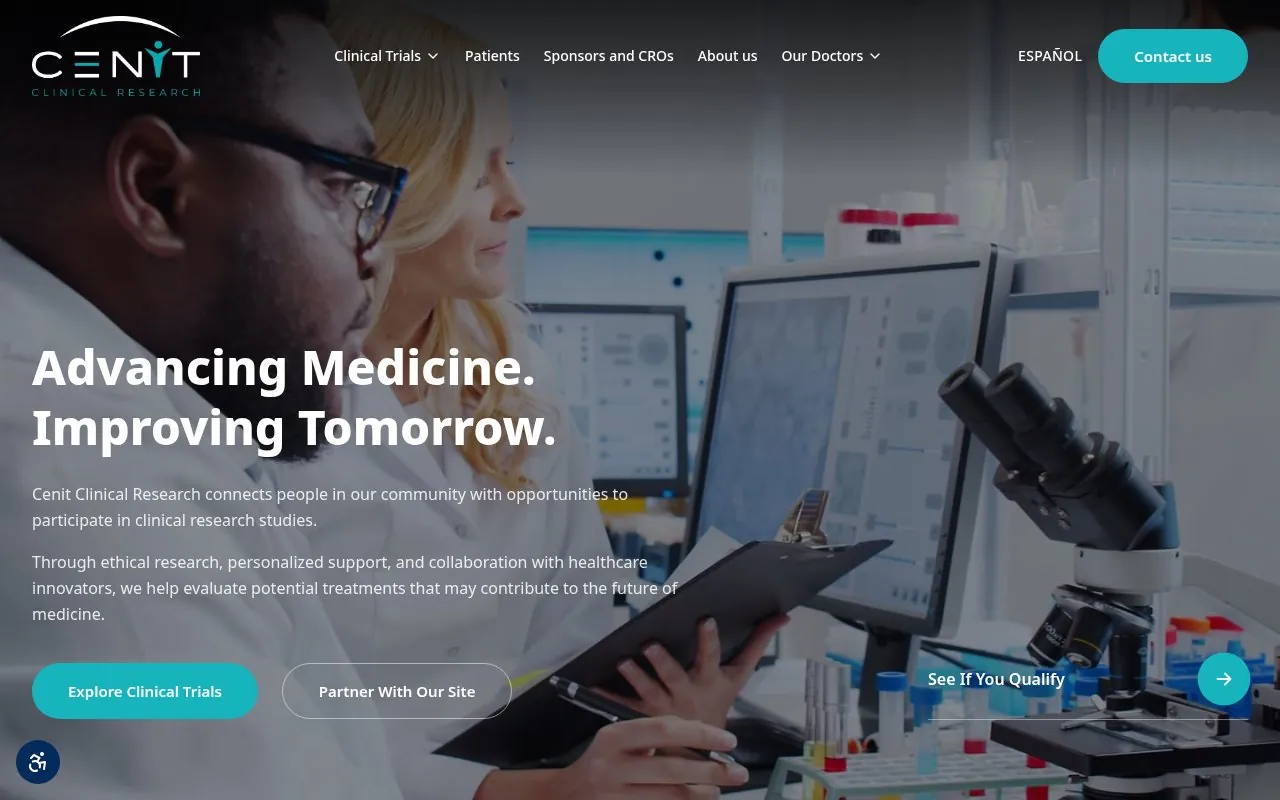
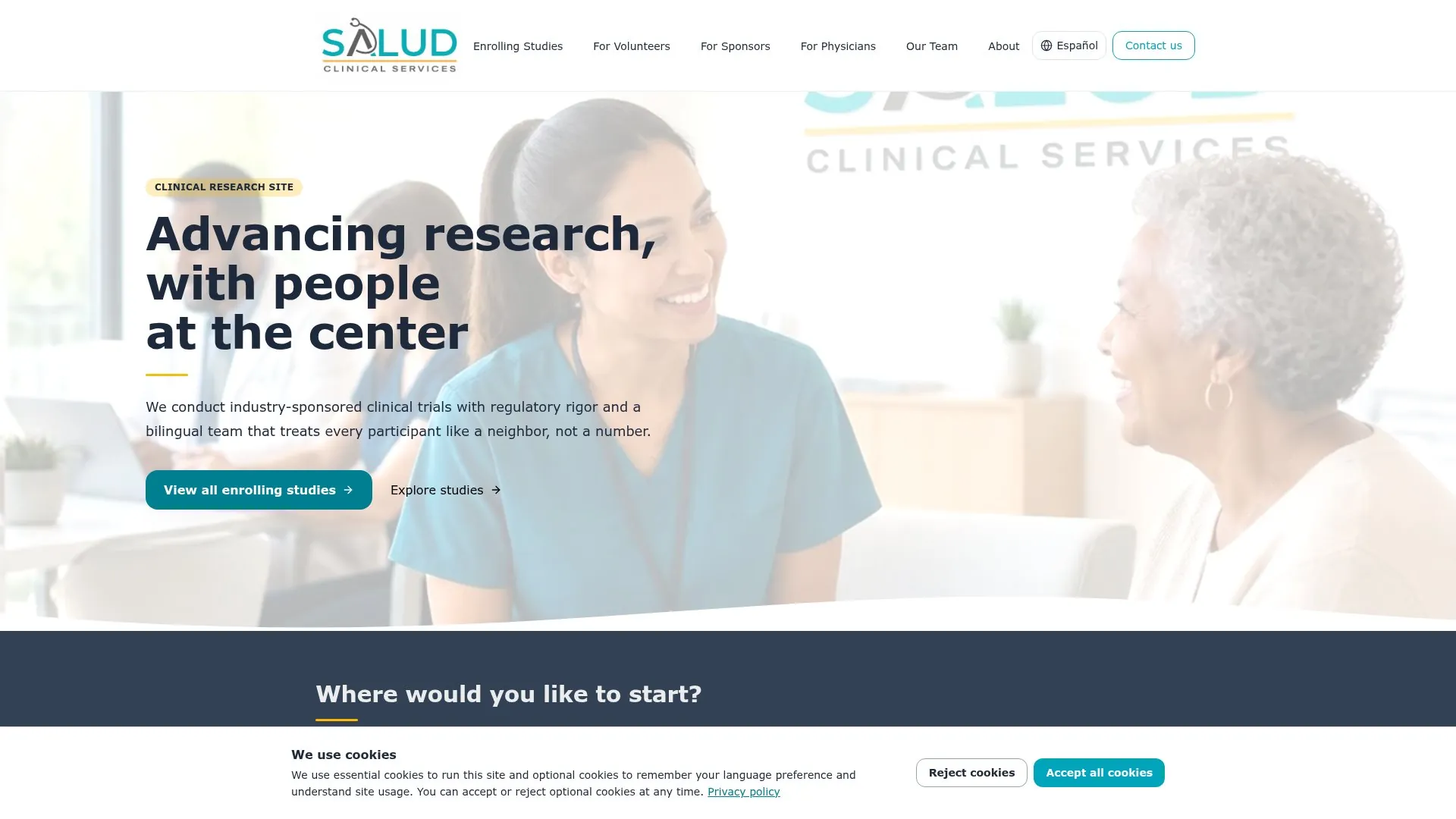
    Salud Clinical Services clinical research website homepage designed by TK Web Services

    Project at a glance

    Client
    Salud Clinical Services
    Industry
    Clinical research
    Location
    Lehigh Acres, Florida (Southwest Florida service area)
    Project type
    Website design, development and SEO
    Primary objective
    Serve three distinct audiences — participants, physicians and sponsors — from one site
    Services provided
    Web design, website development, SEO, local SEO, multilingual content, custom development, conversion strategy
    Languages
    English with Spanish support
    Website
    saludclinicalservices.com

    About Salud Clinical Services

    Salud Clinical Services is a clinical research site based in Lehigh Acres, Florida, that runs industry-sponsored clinical trials across Southwest Florida. The organization sits at the intersection of three groups: community members who may want to participate in a study, physicians who refer patients into research, and pharmaceutical sponsors and contract research organizations (CROs) that need a reliable site to run their trials.

    That structure makes clinical research a genuinely different kind of website project than a typical medical practice site. Visitors don't arrive with one shared intent — a prospective participant is looking for a way to potentially access treatment or compensation for their time, a physician is evaluating whether the site is a credible referral partner, and a sponsor or CRO representative is assessing operational capability and study capacity before ever picking up the phone.

    Salud Clinical Services needed a website that could speak clearly to each of these audiences without diluting the message for any of them, while also building the local visibility needed to reach volunteers across the Southwest Florida communities the site serves.

    The challenge

    The digital experience needed to segment three very different audiences — participants, physicians and sponsors — from the very first screen, without forcing any of them to dig through content meant for someone else. A participant landing on a page written for a CRO's operations team would bounce; a sponsor evaluating the site's credibility would be unimpressed by consumer-facing marketing copy alone.

    The site also needed a way to present currently enrolling studies that could grow and change over time — therapeutic areas, trial phases and eligibility windows shift constantly in clinical research — without requiring a full rebuild every time a study opened or closed. A hard-coded list of studies would go stale within weeks.

    Healthcare and clinical research content carries real risk if handled carelessly. The site needed to communicate opportunity and credibility while staying honest about what a research site can and cannot promise: participation is voluntary, eligibility is only confirmed through the study process itself, and general health information is not medical advice. None of this could read as a compliance disclaimer bolted onto marketing pages — it needed to be part of how the content was written and organized from the start.

    Strategy

    The core architectural decision was to organize the homepage around audience-based journeys rather than a single generic navigation. From the top of the page, a visitor self-selects into one of three paths: join a study, sponsor or CRO inquiries, or physician referral. Each path leads to content written in that audience's language — participant pages emphasize what to expect and how the process works, sponsor and CRO content emphasizes site capability and study experience, and physician-facing content emphasizes the referral relationship and what happens after a referral is made.

    Underneath the audience segmentation, the site needed a second axis of organization: the studies themselves. Rather than describing research in the abstract, the strategy grouped enrolling studies by therapeutic area — cardiology, diabetes and endocrinology, respiratory and pulmonology, neurology, dermatology, vaccines and infectious disease, and women's health — so both a prospective participant with a specific condition and a sponsor evaluating recruitment reach in a given category could find relevant information quickly.

    Because Salud Clinical Services serves a wide geography from a single Lehigh Acres site, local SEO strategy extended the therapeutic-area structure into a set of Southwest Florida service-area pages covering Fort Myers, Cape Coral, Naples, Port Charlotte, Venice and the surrounding region. This gives the site a way to be genuinely useful and locally relevant to searchers in each community, rather than relying on a single generic “Southwest Florida” page to carry all of that search intent.

    Multilingual support in Spanish was treated as a core requirement rather than an add-on, reflecting the bilingual community the site serves. Content, forms and calls to action needed to work naturally in both languages so that participation was not gated by which language a visitor searched in.
    The solution

    Audience-segmented information architecture

    The site's top-level structure is built around three journeys — participants, sponsors/CROs and referring physicians — each with its own entry point, navigation emphasis and calls to action, so no single audience has to wade through content meant for another.

    Participant education path

    A dedicated content path walks prospective participants through what a clinical trial is, how the participation process works step by step, what informed consent means, and what rights a participant has throughout a study, before ever asking for a commitment. This builds understanding and trust ahead of the enrollment conversation.

    Scalable enrolling-studies architecture

    Rather than hard-coding individual trials into page templates that would need constant manual rebuilding, the studies listing is structured around consistent, reusable attributes — therapeutic category, trial phase, condition, general age range and, where relevant, a compensation indicator. This structure lets the list of currently enrolling studies be updated as trials open and close without redesigning the page each time.

    Therapeutic-area organization

    Content is grouped into recognizable therapeutic areas — cardiology, diabetes/endocrinology, respiratory/pulmonology, neurology, dermatology, vaccines/infectious disease and women's health — giving participants a familiar way to find studies relevant to their own health and giving sponsors a clear view of the site's recruitment experience in a given category.

    Southwest Florida service-area pages

    Dedicated pages for Fort Myers, Cape Coral, Naples, Port Charlotte, Venice and surrounding Southwest Florida communities extend the site's local relevance beyond the Lehigh Acres address, reflecting how far participants are realistically willing to travel for a study visit.

    Risk-aware content design

    Every participant-facing page is written to be encouraging without overpromising: participation is presented as voluntary, general health content is framed as education rather than medical advice, eligibility is described as something confirmed through the study process rather than guaranteed by the website, informed consent is positioned as a required step before participation, and forms are designed to avoid inviting sensitive medical details before a secure, appropriate channel is available.

    Multi-audience contact architecture

    Instead of a single generic contact form, inquiry paths are separated by audience, so a prospective participant, a physician making a referral and a sponsor or CRO evaluating the site each reach the right conversation faster.

    Key features

    Three-path homepage journey

    Segmenting participants, sponsors/CROs and physicians from the first screen reduces bounce and gets each visitor to relevant content immediately, instead of asking them to interpret a one-size-fits-all homepage.

    Structured, attribute-based study listings

    Organizing studies by therapeutic category, phase, condition, age range and compensation indicator (where relevant) means the enrolling-studies list can be kept current without ongoing redesign work — critical in a field where study status changes frequently.

    Therapeutic-area pages

    Grouping content by condition area gives both participants and sponsors a faster, more relevant path to information than a flat list of unrelated study announcements.

    Southwest Florida local coverage

    Service-area pages for Fort Myers, Cape Coral, Naples, Port Charlotte and Venice help the site show up for participants searching from communities near — but not in — Lehigh Acres, widening the practical recruitment radius.

    Participant rights and consent content

    Clear, plain-language explanation of informed consent and participant rights helps prospective volunteers feel informed before they ever start the enrollment process.

    Bilingual English/Spanish experience

    Content built to work naturally in both English and Spanish reflects the bilingual community the site serves, rather than treating Spanish as an afterthought translation layer.

    Multi-audience contact paths

    Separate inquiry routes for participants, physicians and sponsors/CROs mean each message reaches the right internal process from the start.

    Search architecture

    The site's SEO architecture follows the same logic as its content architecture: broad clinical-research intent narrows into enrolling studies, which narrow into therapeutic areas, which narrow further into Southwest Florida service-area pages. This gives search engines a clear hierarchy to crawl and gives searchers with very different levels of specificity — from general research interest to a specific condition in a specific city — a page built for exactly what they're looking for.

    Local SEO was structured around the reality that a clinical research site draws participants from a wider radius than a typical local business, since people are often willing to travel further for a study opportunity than for routine care. Dedicated pages for Fort Myers, Cape Coral, Naples, Port Charlotte and Venice capture that regional search intent while keeping the Lehigh Acres location clearly established as the operational base.

    Therapeutic-area pages double as long-term SEO assets: unlike individual study listings, which change as trials open and close, condition-based content around cardiology, diabetes and endocrinology, respiratory and pulmonology, neurology, dermatology, vaccines and infectious disease, and women's health remains relevant regardless of which specific study is currently enrolling.

    How the site is structured
      • Clinical research site
      • Enrolling studies
      • Therapeutic areas
      • Southwest Florida service areas

    Conversion strategy

    Because the site serves three audiences, conversion is not a single funnel but three parallel paths, each ending in the right next step: a participant inquiry for someone interested in joining a study, a referral pathway for physicians, and a direct sponsor/CRO inquiry channel for organizations evaluating the site.

    For prospective participants, the path deliberately builds understanding before asking for action — explaining what a trial is and how participation works before presenting a way to express interest — so that inquiries arrive from people who already have a realistic picture of what they're signing up to learn more about.

    For sponsors and CROs, the emphasis shifts from education to credibility: clear presentation of therapeutic-area experience and site organization gives evaluators the information they need to take the next step toward a direct conversation.

    Outcome

    • Salud Clinical Services now has a website architecture that can speak to participants, physicians and sponsors from a single platform without any one audience crowding out another.
    • The therapeutic-area and structured study-listing architecture created a scalable foundation for the enrolling-studies content, so new trials can be added and closed studies retired without requiring page-by-page redesign.
    • The Southwest Florida service-area structure created a scalable foundation for local SEO, giving the site a genuine reason to rank for participant searches originating in Fort Myers, Cape Coral, Naples, Port Charlotte and Venice, not just Lehigh Acres.

    What this demonstrates

    This project shows TK Web Services' ability to design information architecture for genuinely multi-audience organizations, structure content that scales instead of going stale, and handle sensitive healthcare subject matter with care — building trust through clarity rather than overstated claims.

    Capabilities demonstrated

    • Multi-audience UX architecture
    • Healthcare content strategy
    • Local SEO for multi-city service areas
    • Scalable content structures
    • Bilingual website content
    • Conversion-path design
    • Custom development

    Industry expertise

    Clinical Research Website Development

    Explore clinical research: solutions

    Frequently Asked Questions

    What should a clinical research website include?
    At minimum, a clinical research site needs clear participant education (what a trial is, how the process works, informed consent and participant rights), a way to present currently enrolling studies, and separate paths for the other audiences a research site works with — typically referring physicians and study sponsors or CROs.
    How can one website serve both participants and sponsors?
    By segmenting the experience from the homepage forward. Rather than one generic message for everyone, the site directs participants, physicians and sponsors into distinct paths, each with content and calls to action written for that audience's actual questions.
    Why do service-area pages help a clinical research site's recruitment?
    Participants are often willing to travel a meaningful distance for a study opportunity, so a site that only optimizes for its home city misses searchers in nearby communities. Dedicated pages for surrounding areas like Fort Myers, Cape Coral, Naples, Port Charlotte and Venice give the site a chance to be found by those searchers directly.
    How do study listings stay current without constant redesign?
    By building the listings around consistent, reusable attributes — therapeutic category, phase, condition, general age range and a compensation indicator where relevant — instead of one-off custom pages per study. That structure lets studies be added or removed as content updates rather than development projects.

    Planning a clinical research or healthcare website?

    TK Web Services designs and builds multi-audience healthcare and clinical research websites with the local SEO and content architecture to support them. Get in touch to talk about your project.

    Clinical research · Web design · Website development · SEO · Local SEO · Multilingual development · Custom development · Conversion optimization

    Let's Work Together

    Ready to transform your business with custom software solutions? Get in touch with us today.

    Get in Touch

    Why Choose TK Web Services?

    • Full-stack software development expertise
    • Proven track record of successful implementations
    • Scalable solutions that grow with your business
    • Dedicated support and ongoing optimization

    0/2000 characters